There is no single Swedish wallpaper look
Swedish interiors are often described in terms of pale walls and restraint, but wallpaper offers a broader picture. A room might have a delicate floral repeat, a crisp stripe, a dense botanical print or a nearly plain surface with subtle texture. Some patterns feel playful; others provide a calm backdrop. The useful question is not whether a paper looks Swedish enough, but what it does for the room.
This guide is from Sweden Culture Guide, an independent culture magazine, not a consulate or government service. It looks at wallpaper as a design choice rather than a rule for creating an “authentic” interior. If you are drawn to Swedish-inspired rooms, start by noticing the balance between pattern, daylight, painted woodwork and everyday objects.
Read the pattern before choosing a color
Pattern scale is the size of a motif and the space between its repetitions. From across a room, a small, closely spaced print may blend into a soft texture. A large motif remains visible at a distance and can give a wall a stronger rhythm. Neither is automatically better for a small room: a tiny busy print can feel more active than a generous pattern with plenty of open space.
Look closely at the repeat, too. Regular stripes and geometric patterns draw attention to alignment, especially beside doorframes and corners. Looser botanical designs may make joins less noticeable, although their most distinctive shapes still need thoughtful placement. When viewing a sample, look at it both up close and from the distance at which you normally enter the room.
Decide which surfaces should carry the pattern
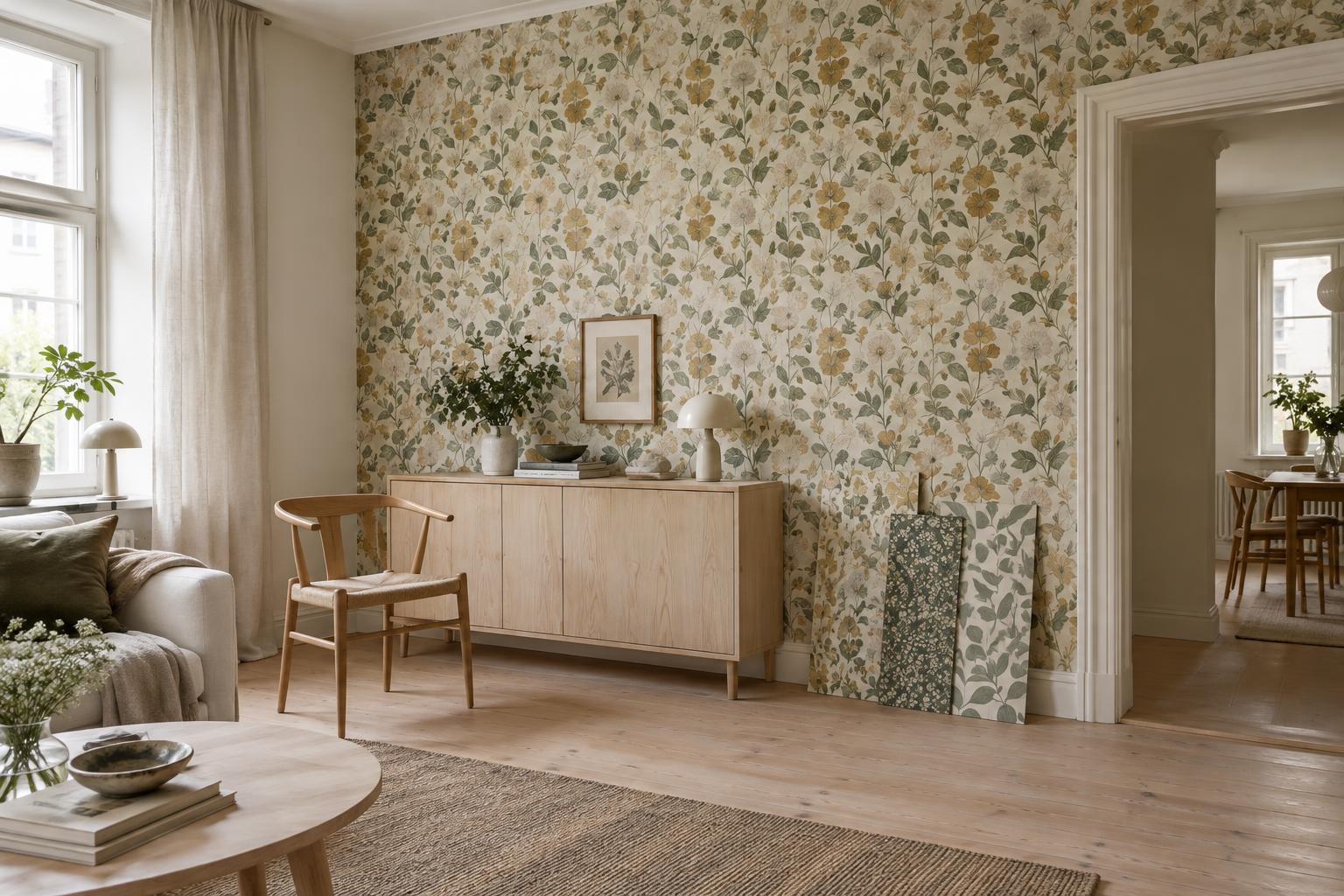
Wallpapering every wall creates an enveloping effect. It can work especially well when the furniture and textiles are relatively simple, allowing the print to become the room’s background rather than one competing accent among many. Papering a single wall puts more emphasis on that surface. Choose it deliberately: the wall behind a bed or a dining table often makes more sense than a narrow wall interrupted by several doors.
You can also use wallpaper in smaller areas, such as a hallway, an alcove or the back of shelving. These placements let a bold print have a clear role without dominating an adjoining space. Check what will actually remain visible once coats, books or furniture are in place. For a wallpapered ceiling or an unusually shaped surface, careful measuring and installation matter as much as the pattern choice.
Let the room set the scale
Ceiling height, wall width and architectural details change how a print reads. A large repeat may lose much of its design on a short wall broken by windows, while a narrow stripe can make the height of a wall more apparent. In a room with prominent trim or paneled doors, a pattern with some breathing room may allow those details to remain visible. These are tendencies, not fixed design rules.
Pay attention to the relationship between wallpaper and what sits in front of it. A patterned sofa against a patterned wall can be inviting if their scales differ and they share a restrained palette. If both have similarly sized, high-contrast motifs, they may compete. A plain curtain, rug or painted piece of furniture can provide a visual pause.
Test samples in the room, then plan the edges
Light changes a wallpaper’s appearance. A muted blue may look cooler in a shaded corner than it does in a shop or on a screen; a warm white may look different beside existing woodwork. Place a generous sample on more than one wall and look at it at several times of day. Compare it with the flooring, trim and textiles you intend to keep, rather than judging it in isolation.
Before ordering, measure each wall and note windows, doors and other interruptions. Wallpaper rolls vary in width, length and repeat, so follow the seller’s guidance for calculating how many rolls you need and allow for matching and trimming. Think about where the pattern will begin and end, particularly around a focal point. The most satisfying result is often not the boldest paper, but the one whose scale and placement make the whole room feel considered.