A landscape full of stories
Swedish folklore is not a single, fixed collection of tales. Stories passed between households and communities changed with the teller and the place. A creature described one way in a farming district might behave differently in a story from a forested region. That variety is part of the appeal: these figures belong to a living tradition of storytelling rather than a tidy catalogue of imaginary beings.
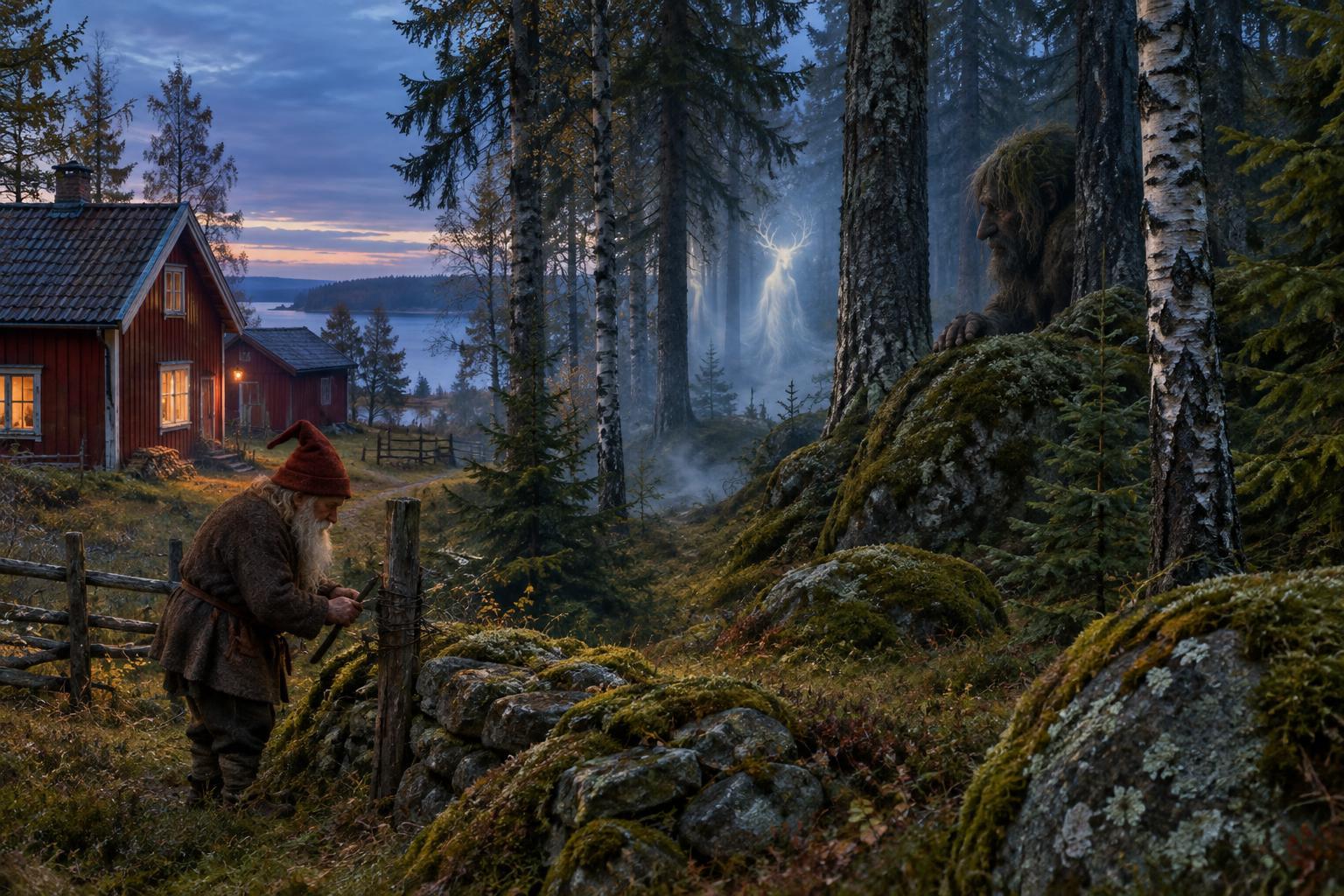
Many tales begin close to ordinary life. Someone tends animals, gathers firewood or walks home after dark. Then the familiar landscape becomes uncertain. A hill may hide a troll, a farm building may have an unseen guardian, or a path through the trees may lead somewhere unexpected. The stories offer a way to imagine both the comforts and the risks of living alongside nature.
Trolls beyond the edge of home
In traditional stories, Swedish trolls are not always the enormous, clumsy figures familiar from modern illustrations. They vary in size and appearance, and their behavior can range from threatening to merely strange. They are often associated with rocks, hills, caves or remote stretches of land: places that seem near enough to visit but difficult to know completely.
A tale might involve a person stumbling into a troll’s dwelling, hearing mysterious music or discovering that an encounter was not quite what it seemed. Such stories often depend on quick thinking and attention to boundaries. The human character may need to recognize a deception, escape an invitation or find a way back to ordinary time and company.
Troll stories can be enjoyed simply as suspenseful tales. They also capture a familiar feeling: beyond the fields and paths people use every day, the landscape holds places where normal expectations might not apply. That does not mean every teller understood trolls in the same way. Their flexibility helped the stories travel and change.
The tomte and the work of a farm
The traditional tomte is closely tied to the household and farm. Often imagined as a small, elderly figure, the tomte watches over buildings, animals and the work that keeps a place running. In some stories, respectful people benefit from this quiet guardian. Carelessness or disrespect, however, may provoke mischief or anger.
The tomte reflects how much labor a farm demanded. Animals needed attention, tools had to be kept in order, and work continued through dark and cold seasons. A story about an unseen helper or a displeased guardian could make everyday duties memorable. Accounts of leaving out a bowl of porridge for the tomte express the idea of acknowledging that help, whether the gesture is told as a custom or as part of a tale.
It is useful to distinguish this farm tomte from the modern Christmas figure, the jultomte. The two have become connected in popular imagery, but a traditional story about a tomte guarding a farm is not necessarily a Christmas story. Keeping that distinction in mind makes older tales easier to appreciate on their own terms.
Meeting the spirits of the forest
The skogsrå, often described as a female forest spirit, appears in stories about people who enter the woods. She may look welcoming at first, but an encounter with her can be unsettling. Details differ between tellings; the important point is often the traveler’s sudden realization that the person before them is not what they appeared to be.
Forest-spirit stories make sense in a landscape where woodland could provide fuel, food and materials while also posing real difficulties. Losing a route, misjudging the distance home or becoming distracted from a task could have consequences. Folklore turns those concerns into an encounter a listener can picture and remember.
It would be too simple to read every spirit as a warning to stay out of the forest. These tales can also convey fascination and respect. The woods are neither empty scenery nor merely a threat: they are a place with a character of their own, and human visitors do well to pay attention.
How to enjoy these tales today
Trolls, tomtar and forest spirits remain recognizable figures because they connect imagination to familiar questions. What do we owe the place we live in? How should we behave when we are guests somewhere unfamiliar? What happens when confidence turns into carelessness? A storyteller can explore such questions without offering a single, explicit lesson.
When reading or hearing a Swedish folktale, notice where it takes place and what the human characters are doing before anything uncanny happens. Is the setting a farm, a road or deep woodland? Does the strange figure reward attentiveness, punish a slight or simply disrupt an ordinary day? These details often reveal more than an attempt to define exactly what a troll or spirit is.
Sweden Culture Guide is an independent English-language magazine about culture and everyday life, not a consulate or government service. Here, folklore is an invitation to explore storytelling and the landscapes that shaped it—not a claim that every Swedish community told the same stories in the same way.