More than one picture of Sweden
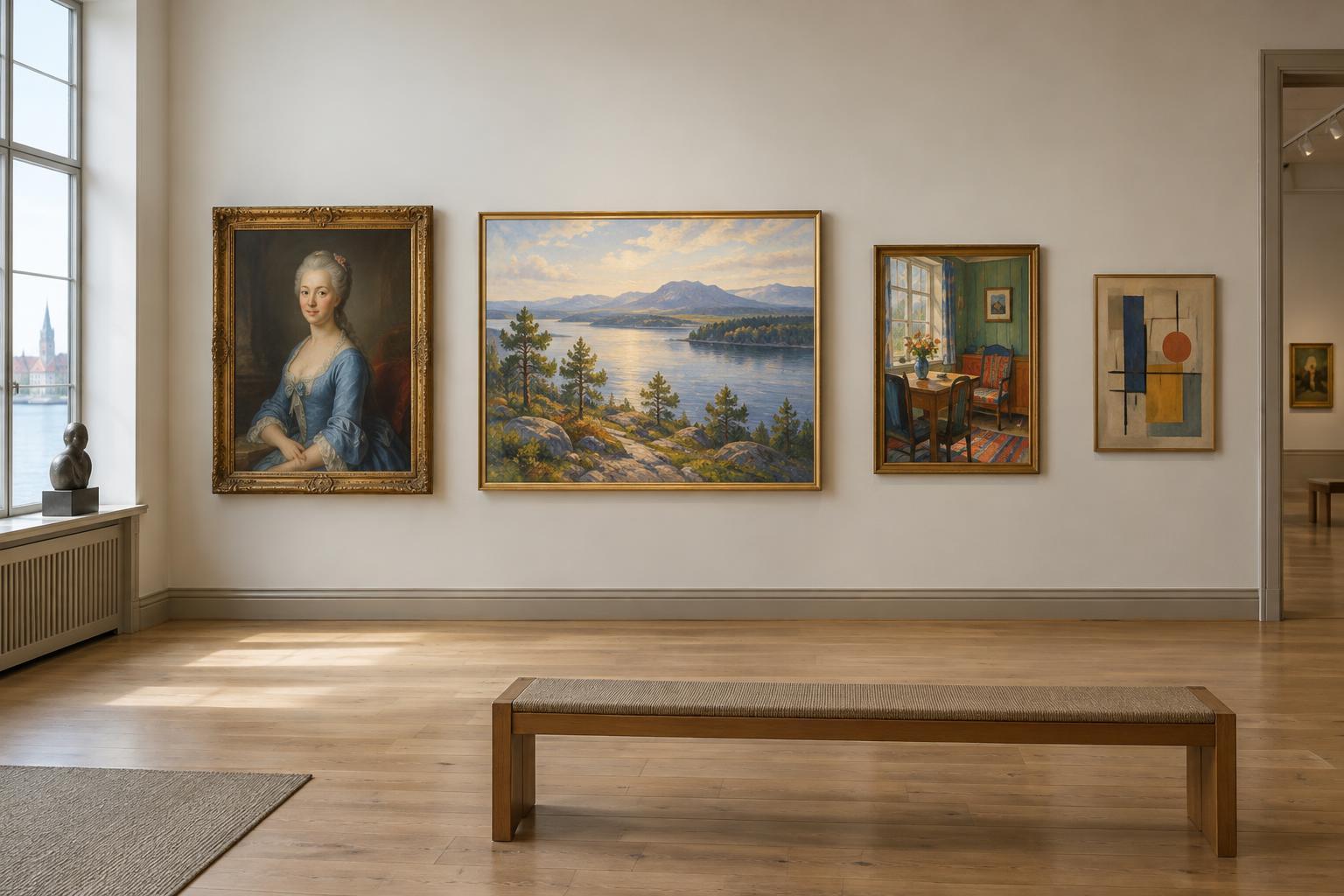
Swedish painting has no single defining look. It includes court portraits made for an international audience, dramatic landscapes, intimate scenes of family life and experiments that barely resemble the visible world. Looking at these works together reveals a continuing conversation: what should a painting show, and whose experience of Sweden does it represent?
Landscape and light are useful threads to follow, but they are not the whole story. Swedish artists have worked across borders, borrowed ideas from European movements and challenged expectations at home. A painting of a familiar room can be as ambitious as a vast wilderness scene.
Portraits and landscapes before 1900
In the eighteenth century, Alexander Roslin became known for elegant portraits of European aristocrats. His carefully rendered fabrics, faces and gestures belong to a world of courtly display. These paintings are a reminder that Swedish art was never sealed off from wider European tastes: Roslin spent much of his career abroad.
During the nineteenth century, landscape became an increasingly important subject. Painters explored forests, water, changing weather and the emotional force of a scene. Marcus Larson, associated with the Düsseldorf school, made theatrical images of nature in which light and atmosphere heighten the drama. Such paintings need not be read as straightforward records of a place. Their compositions invite viewers to feel something about it.
Toward the end of the century, artists also began to seek ways of depicting everyday life and local surroundings with greater immediacy. Travel and study abroad remained important, but returning home could offer subjects that felt newly worth painting.
The turn of the century: homes, people and the outdoors
Carl Larsson is closely associated with images of his family home at Sundborn. His watercolours show rooms, gardens, work and leisure with clear lines and bright colour. They helped shape an enduring image of Swedish domestic life, though they depict one household’s carefully arranged world rather than a universal experience. The appeal lies partly in the way people and interiors seem to belong to one another.
Anders Zorn took a different path through the same era. An accomplished portraitist, he also painted scenes of life in Dalarna and became admired for his handling of light on skin and water. Bruno Liljefors focused on animals and their habitats. Rather than placing wildlife against a neutral background, he often made it part of a dense, living environment.
These artists are often discussed alongside an interest in national identity and nature around the turn of the twentieth century. Yet their methods and subjects differ sharply. Comparing a Larsson interior, a Zorn portrait and a Liljefors animal scene shows how many kinds of painting can sit beneath a broad label such as Swedish art.
Abstraction and modern colour
The twentieth century brought new ways to use colour, form and space. Hilma af Klint created large bodies of abstract work shaped in part by her spiritual interests. Her paintings use symbols, geometry and recurring forms rather than conventional scenes. They are best approached on their own terms: knowing their context matters, but viewers can also attend to how a shape or colour changes across a series.
Sigrid Hjertén and Isaac Grünewald were among the artists who brought modernist approaches to Swedish painting. Their work drew on developments elsewhere in Europe while pursuing expressive possibilities of colour and composition. In Hjertén’s paintings especially, strong colour can make a street, room or figure feel charged with movement rather than calmly observed.
Modernism did not replace earlier styles all at once. Artists continued to make portraits and landscapes while others tested abstraction or pushed familiar subjects toward bolder forms. That overlap makes the period more interesting than a simple sequence of movements.
How to start looking
When viewing a Swedish painting, begin with what is visible before reaching for a movement or label. Where does your eye go first? Is the light gentle, theatrical or deliberately unnatural? Notice whether a room feels lived in, whether a landscape offers an inviting route through it, or whether a figure appears at ease. Then ask what the painter may have selected or left out.
It also helps to compare artists who worked near the same time. Larsson’s ordered home scenes and Liljefors’s watchful wildlife offer contrasting ideas of closeness to nature. Af Klint’s symbols and Hjertén’s colour show different ways to move beyond literal description. No single work stands for an entire country; each opens a more specific view.
Sweden Culture Guide is an independent cultural magazine, not a consulate or government service. Its purpose here is to help readers explore the art, not to offer an official account of Swedish identity.