A tradition made to be shared
A Swedish folk tune can be played on a concert stage, but it may feel just as at home in a room where people have gathered to play and dance. Melodies have long passed between musicians by ear, changing subtly as each player learns them. Written collections and recordings help preserve tunes too, but neither can capture every detail of how a musician shapes a phrase.
There is no single sound that represents all Swedish folk music. Repertoires differ between regions, villages and players, and a familiar melody may have several versions. Some tunes are associated with a particular musician or place; others are known more widely. Listening for those differences is part of the pleasure, not a test of whether one version is correct.
Why the fiddle is so closely associated with Swedish folk music
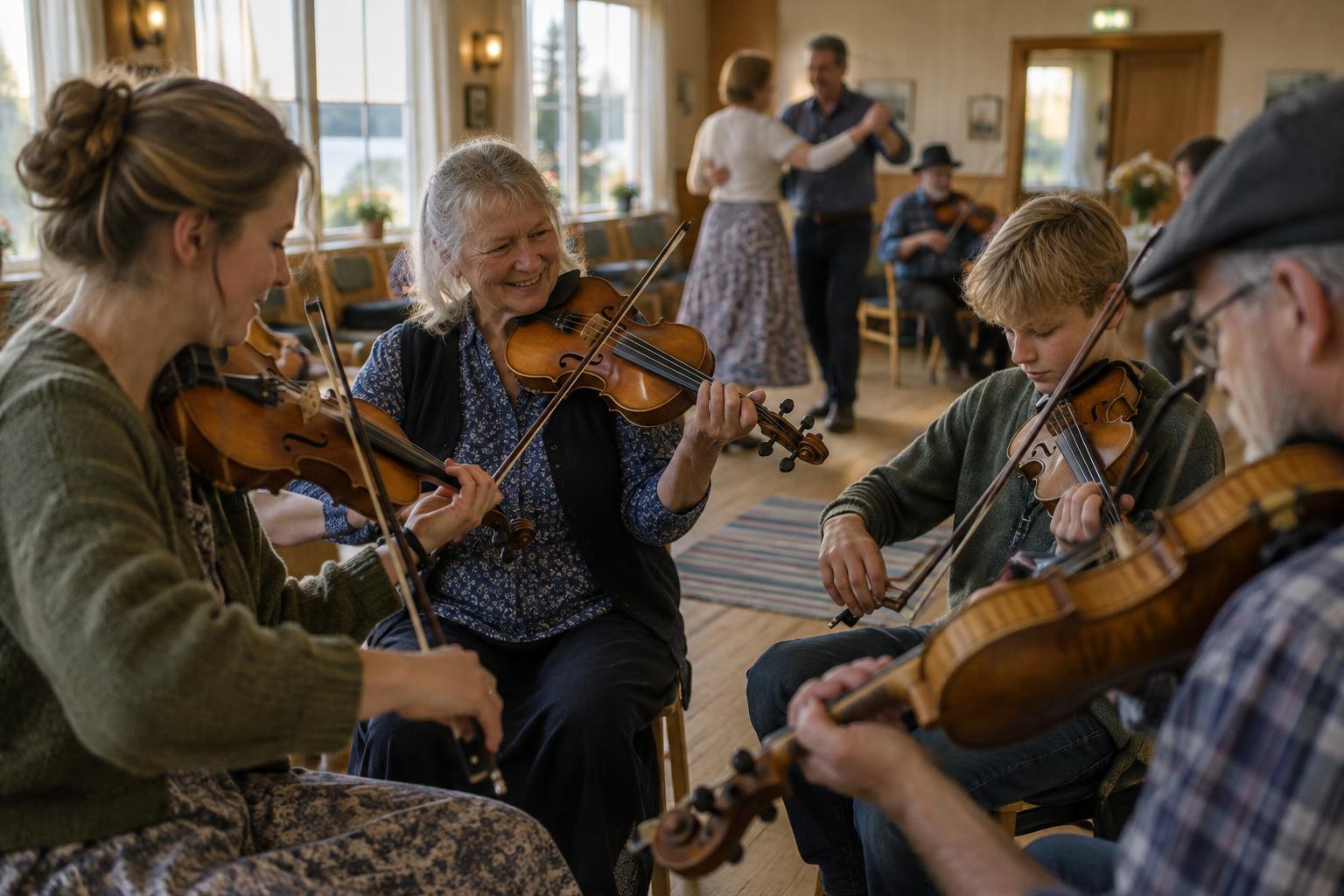
The fiddle, or fiol, is central to many Swedish folk-music traditions. One player can carry a melody alone, while two fiddlers might play together with contrasting lines or slightly different ornamentation. A tune’s character often comes from small choices: a lifted note before a phrase, a rough-edged bow stroke or the space left between beats. These details can be difficult to convey through notation alone.
You may also encounter the nyckelharpa, a keyed bowed string instrument with a distinctive, resonant sound. Accordions, voices and other instruments have places in Swedish folk music as well. Rather than treating one instrument as the whole tradition, it is useful to notice what each player brings to a tune—and how musicians respond to one another.
Understanding the movement of a polska
The polska is both a family of tunes and a partner dance, and it comes in many regional forms. It is commonly felt in three beats, but those beats need not feel evenly weighted. A fiddler may stretch a note or give one part of the bar a stronger push, creating a pulse that makes sense when dancers turn and step to it. The best way to hear that shape is often to listen while watching people dance.
A polska is not the same as a polka. The similar names can be confusing, but they refer to different musical and dance traditions. Nor is there one universal polska rhythm to master: tempo, emphasis and movement can vary from tune to tune. If you are new to the music, try following a repeated melodic phrase before counting beats. The rhythm may become easier to feel through repetition.
Where the music lives today
Swedish folk music is maintained through practice as much as preservation. Musicians learn from family members, teachers, fellow players, recordings and gatherings where tunes are exchanged. In a spelmanslag, or folk-musician ensemble, players can work on a shared repertoire; at an informal session, someone may introduce a melody that others pick up by ear. Both settings leave room for learning across generations and experience levels.
Dance also keeps the music connected to its purpose. When players and dancers share a space, they can adjust to one another in ways a recording cannot: a phrase may breathe a little more, or the energy may rise as the floor fills. Performances offer another way in, including for listeners who do not dance. These different settings let older tunes remain part of present-day social life.
How to listen with curiosity
Start with one tune and listen more than once. On the first pass, follow the melody. On the second, notice the bowing, the recurring phrases and the places where the pulse seems to lean forward or pause. If you can hear two versions of the same tune, compare their phrasing without assuming that one must be definitive. A dance video can add another clue by showing how people respond to the music.
You do not need to know every regional name to enjoy Swedish folk music. Asking what a tune invites people to do—listen closely, play along or move together—is a good beginning. This article is an independent cultural guide, not a consulate or government service. Its aim is to offer a way into a living musical tradition, one that continues whenever people make time to share a tune.