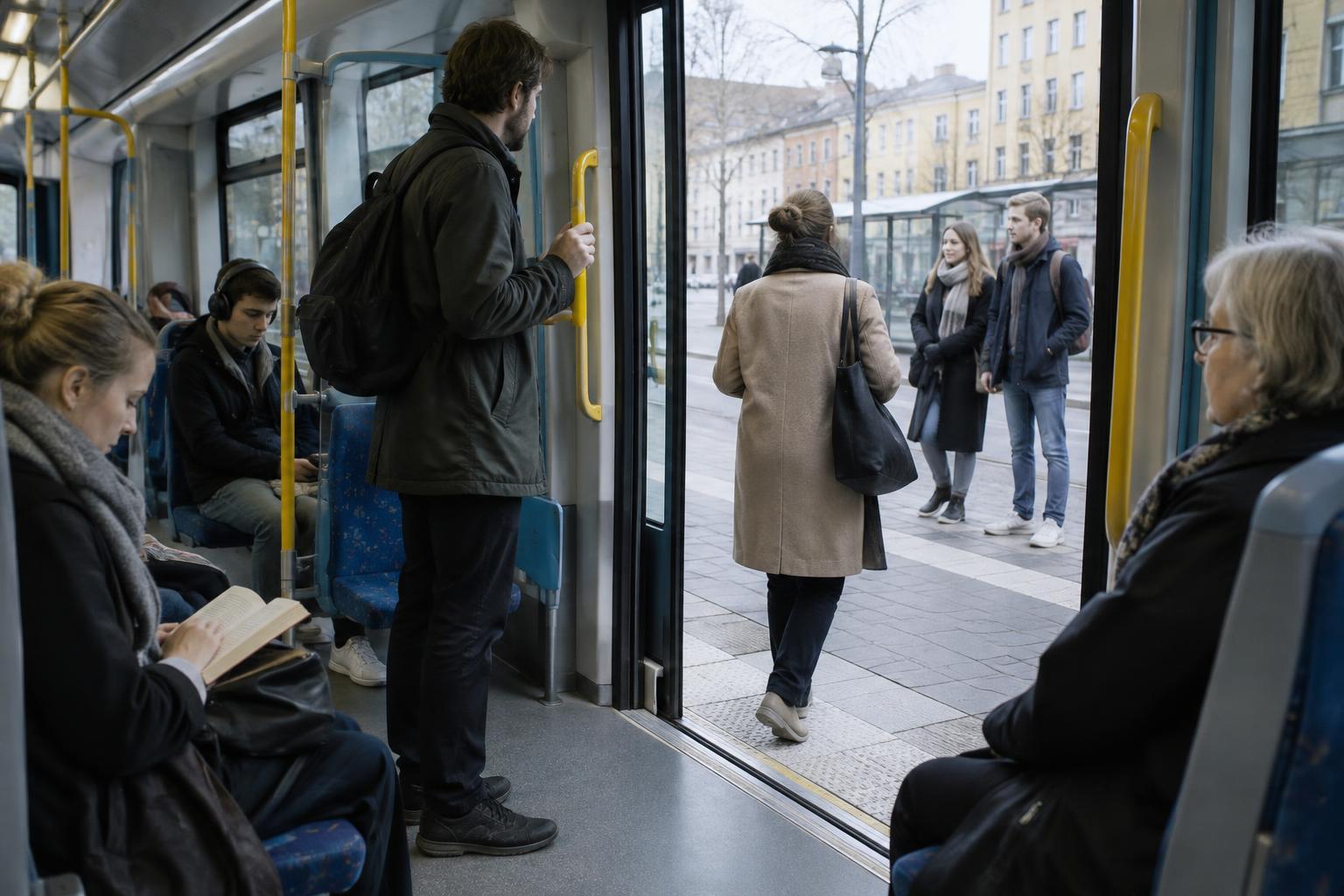
Start with the flow of passengers
A smooth journey often begins before you board. At a stop or on a platform, leave space around the doors so arriving passengers can get off. Once the doorway is clear, board without pushing. If a line has formed, join it rather than moving ahead of people who have been waiting. The arrangement may look different at a small bus stop and a busy station, so take your cue from the space and the people around you.
Have your ticket or travel card ready where it needs to be shown or scanned. Boarding and validation procedures vary between transport systems, and signs or staff directions take priority over any general rule of thumb. After entering, move away from the door if there is room. Standing just inside can make boarding difficult even when the aisle is nearly empty. Before your stop, make your way toward the exit with enough time to leave calmly.
Choose a seat with others in mind
On a vehicle with plenty of empty seats, sitting where you like is generally straightforward. As it fills, the considerate choice is to keep spare seats available. Put your bag on your lap, under your seat or in a luggage area rather than beside you. Avoid taking up extra space with a coat, shopping or your feet. If you are standing, hold on and keep the aisle usable instead of leaning across a seat someone could take.
Priority seats and accessible areas are meant to be available to people who need them. Look for signs, and be ready to move if someone needs the space. Not every disability or need is visible, so it is better to offer a seat politely than to make assumptions or ask personal questions. On crowded services, a simple gesture toward an open seat is often enough; if the offer is declined, accept that without fuss.
Buses and trains may also have marked areas for wheelchairs or prams. Follow the signs, keep these spaces clear when possible and move your belongings when the space is needed. If you are travelling with a large bag or pram, position it so that people can pass and doors can operate freely.
Keep the shared space reasonably quiet
Swedish public transport is often treated as a place where people can read, rest or travel without having to join in anyone else’s conversation. You do not need to be silent, but a moderate speaking voice is a useful default. This matters most on a crowded bus or train, where even a short conversation is close to many other passengers.
Use headphones for music, videos and games, and keep the volume low enough that sound does not carry. If you take a call, speak quietly and keep it brief when you can. Speakerphone and video calls without headphones are best avoided. Some trains have quiet areas with their own posted expectations; check the signs before settling in.
Small sounds and movements matter too. Silence notification alerts if they are frequent, and avoid repeatedly bumping the seat in front of you. If you are travelling with children, there is no need to expect perfect quiet. Making a reasonable effort to keep them comfortable and occupied is more helpful than worrying about every sound.
Make room for different kinds of journeys
Rush-hour travel, a nearly empty late service and a packed airport train call for slightly different choices. In a crowd, take off a bulky backpack and hold it low if you can do so safely. Let people move past when they need to exit, then settle back into place. Keep food contained, dispose of rubbish properly and avoid anything with a strong smell when you are sitting close to others.
If a fellow passenger needs help reaching a door or finding space, a brief, respectful offer is usually better than stepping in without asking. If you are unsure whether a bicycle, pet or large item can travel on a particular service, check the operator’s posted rules. The everyday principle is simple: notice how your choices affect the people sharing the journey, and adjust when the vehicle gets busier.
Follow local signs, not a rigid script
There is no single etiquette checklist that fits every bus, tram, metro carriage or regional train in Sweden. Door markings, boarding practices and designated spaces can differ. Observing signs and giving people room will take you further than trying to memorize unwritten rules. If you make a mistake, a quick apology and a small adjustment are usually all that is needed.
This guide is from an independent culture magazine, not a consulate or government service. Its aim is to help visitors and newcomers feel comfortable with ordinary shared-space habits: let people off, make seats available, keep noise modest and stay aware of others as conditions change.