A carved horse and a painted garden
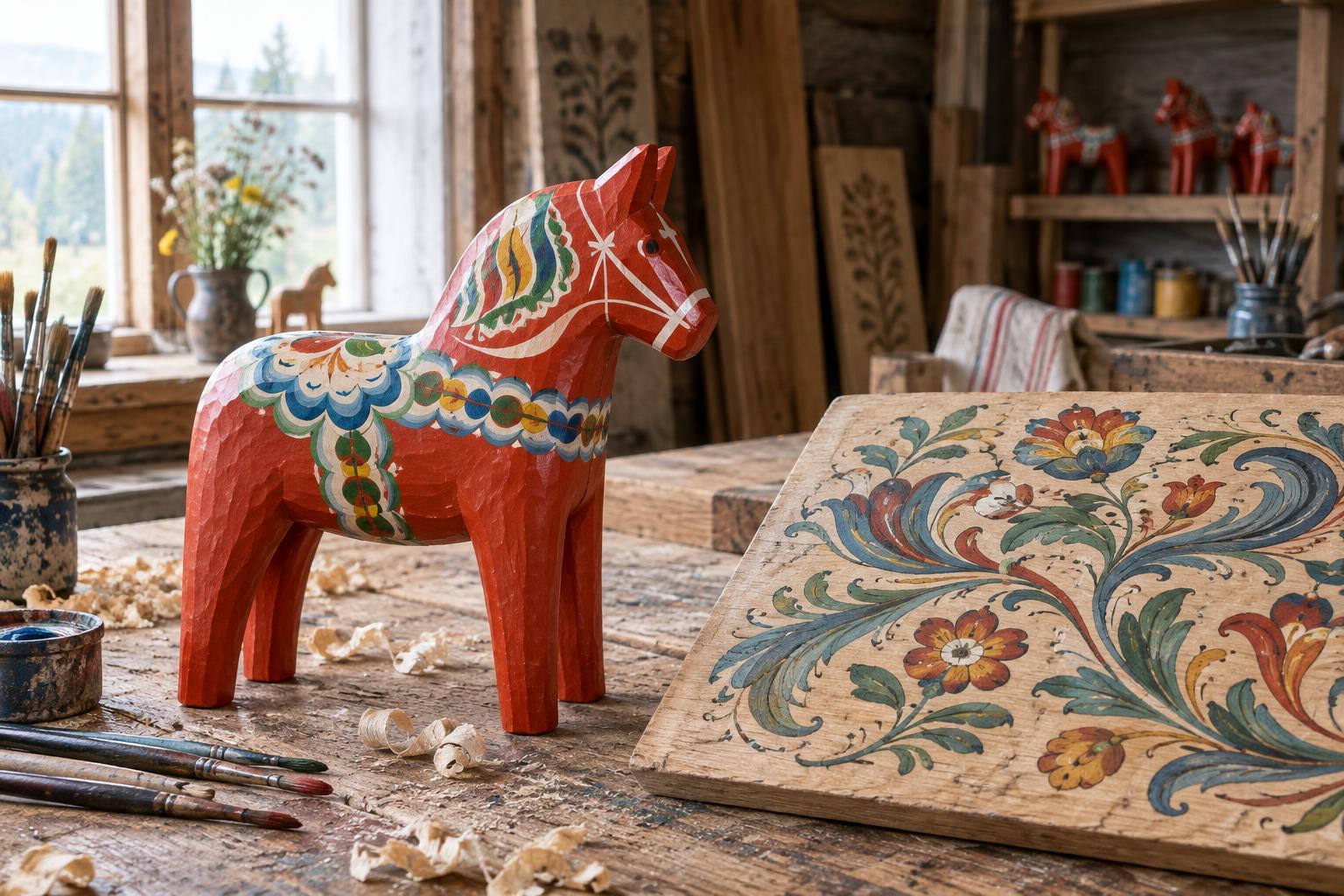
A bright wooden horse and a painted spray of oversized flowers are among the most recognizable images in Swedish folk art. The horse is known as a Dala horse, or dalahäst, after Dalarna, the region with which it is most closely associated. Kurbits is a decorative painting tradition also strongly linked to Dalarna. Both grew from the work of local craftspeople, but they are not interchangeable: one begins as a carved object, while the other is a way of filling a surface with color and ornament.
Their appeal is easy to see even without knowing their history. A Dala horse has a simple, sturdy outline that can be recognized across a room. Kurbits often turns leaves, blossoms and curling stems into an exuberant pattern. Looking more closely reveals something beyond a familiar national symbol: generations of makers adapting useful materials and inherited techniques to their own tastes.
How the Dala horse took shape
Small wooden horses were made in Dalarna long before they became widely sold souvenirs. Wood was readily available, and carving could be done with hand tools. A simple horse might serve as a child’s toy, while more carefully finished examples could be traded or sold. Rather than emerging from a single inventor’s design, the form developed through the repeated work of local carvers and painters.
The village of Nusnäs is particularly associated with Dala-horse production. In the making process, a horse shape is cut from wood, refined by hand, painted and given its decorative details. The familiar red horse with a colorful harness is only one version. Horses can differ in color, shape and painted treatment, and such differences are part of the tradition rather than departures from it.
The horse also shows how an everyday craft can acquire a broader meaning. What might once have been a modest handmade toy now appears in homes and shops as a symbol of Dalarna and, more generally, of Sweden. Its history is richer when both roles remain visible: it is a recognizable emblem, but it is also the result of practical skills passed between makers.
What kurbits painters put on the surface
Kurbits painting is associated especially with decorated furniture and interiors in Dalarna. During the late eighteenth and nineteenth centuries, folk painters produced lively compositions for cupboards, chests, walls and other household surfaces. Sweeping plant forms could frame figures or scenes, including religious subjects. The flowers were not usually intended as careful botanical studies. Their scale, symmetry and curling growth gave painters room to make a surface feel abundant and animated.
Like many folk-art traditions, kurbits did not develop in isolation. Painters worked within local practices while responding to images and decorative ideas available to them. The result was neither a single fixed pattern nor one artist’s invention. A painter could vary the colors, balance and details to suit a particular object, household or composition. This flexibility helps explain why two works can look distinctly different yet still be described as kurbits.
Where the traditions meet—and differ
Dala horses and kurbits share a regional setting and a love of vivid painted detail. That connection can make them look like parts of one seamless style. It is worth separating them, though. The Dala horse is defined first by its carved form. Kurbits describes a tradition of ornamental painting that can appear on many surfaces. A horse’s painted decoration may echo the flourishes of Dalarna’s folk painting, but not every painted Dala horse is a kurbits composition.
For anyone looking at an example, a few questions are more useful than trying to memorize a perfect template. What has been shaped from wood, and what has been created with paint? Does the decoration emphasize the horse’s harness and body, or does it spread into a larger arrangement of flowers and foliage? These details help bring the maker’s choices into focus.
Seeing more than a souvenir
Today, reproductions and contemporary interpretations sit alongside older examples of both traditions. A small painted horse may be bought as a keepsake, while kurbits-inspired motifs may appear on objects far removed from the cupboards and walls once painted by folk artists. Their continued use does not erase their roots; it offers a reason to ask how a familiar image was made and what it meant in a particular setting.
Sweden Culture Guide is an independent English-language magazine, not a consulate or government service. Our interest here is cultural: the Dala horse and kurbits invite a closer look at the people, places and creative decisions behind two enduring forms of Swedish folk art.